Common Questions and Concerns
My child finds it difficult to pay attention, what should I do?
Young children often find it difficult to sit still and pay attention for long stretches of time, and will need a wiggle and to move about the space regularly.
Listening and paying attention are skills that are typically learnt through time and practice.
Generally, up to 12-18 months old, a child is easily distracted and will flit from one thing to another.
Up to 2 years old, a child can concentrate on an activity of their own choosing but cannot tolerate adult interruptions. You may see a lot of tears and refusal at this age!
Until 3 years old, a child will need an adult to ask them to stop what they are doing and listen to an instruction, in order to make sure that the child has heard it. 3 year olds are not great multi-taskers!
From 3-4 years old, children will no longer need an adult to help them change the focus of their attention, but they still can only do one thing at a time.
From 4 years old, you would hope that a child can do a task and listen to an instruction at the same time. Their attention span may still be short but they should be able to learn and listen within a group.
My child isn’t talking, when should I seek help?
Generally, children begin to talk from about 12-15 months old, using 1-3 words.
At 18 months, you may expect a child to be saying 10-50 words.
From 2 years old, many children will use between 50-200 words and will be starting to combine them into very simple phrases.
If your child isn’t quite where you think they should be, it is important not to compare them to others (as every child is unique and the language development journey is different for everyone).
However, it is important to trust your gut.
Early assessment, support and intervention can make a big difference to children who are finding it difficult to use and understand language and communicate effectively.
If you are not sure of what is typical, it is advisable to book an assessment with a Speech and Language Therapist for support, recommendations and potential direct therapy input.
My child’s speech is unclear and I can’t always understand them, do they need Speech Therapy?
Young children often have trouble producing some speech sounds accurately, especially when they are learning to talk and trying to put more words together.
They may make some small errors that only affect some sounds or words, or they make more more errors that make their speech hard to understand, especially when they are talking about something that you have no context for.
Many of these errors will be developmentally appropriate and will get better on their own.
However, if the errors persist or if your child doesn’t seem to be able to say certain sounds at all, then it is a good idea to seek an assessment with a Speech and Language Therapist to get to the bottom of what is going on with your child’s speech.
My child doesn’t show interest in toys, games or people - should I be doing something different?
Some children may play or interact with others a little differently. All play and communication is good. All types of play can help our children to learn and grow.
Whatever stage your child is at, it can help to:
Join them at their level (e.g. on the floor)
Limit your language (e.g. rather than asking lots of questions and using long sentences, try using one or two words at a time to comment on what is happening)
Follow their lead within their play idea (e.g. rather than trying to alter their play and interaction to something that you think is ‘correct’’)
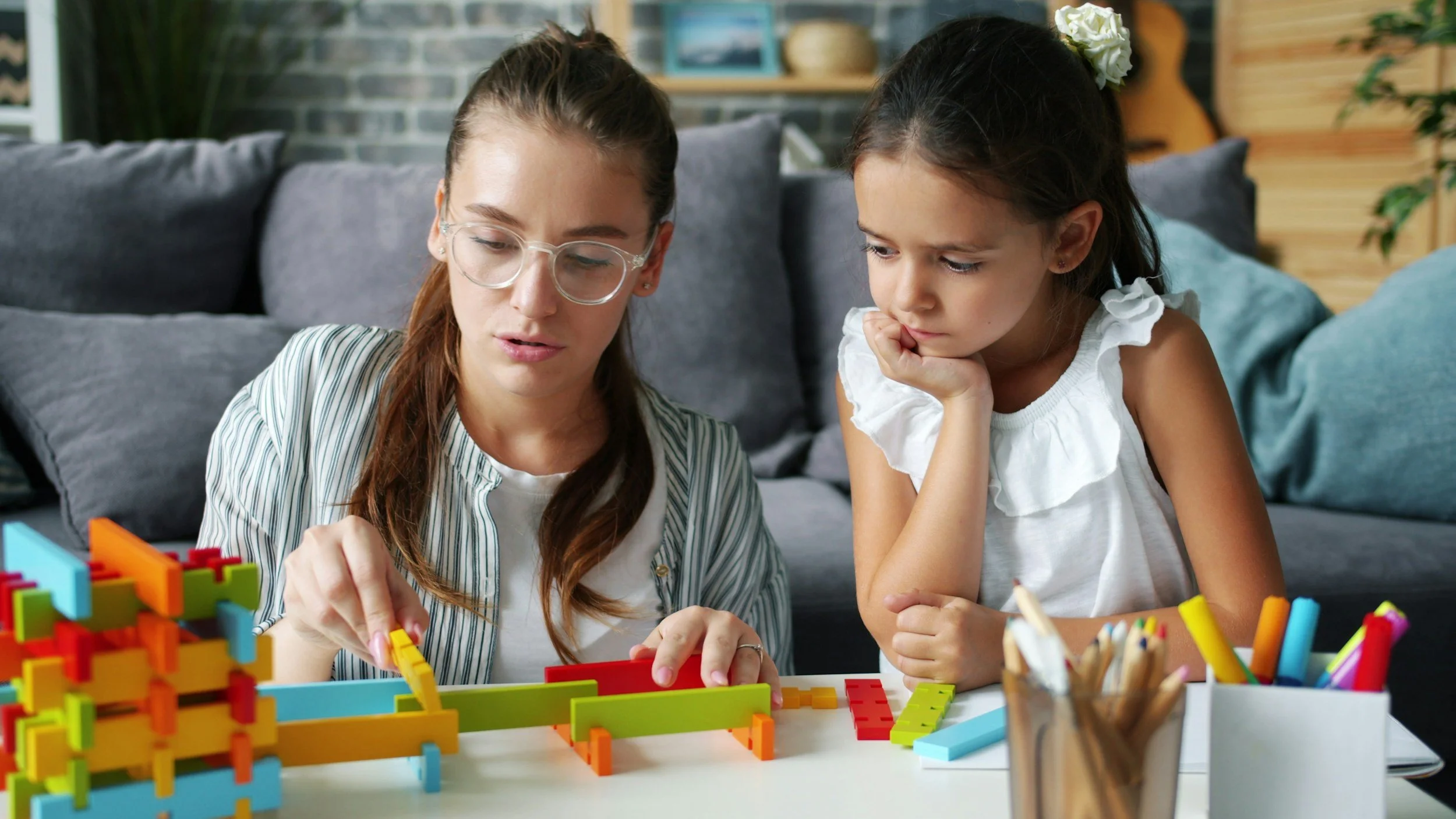
This might look something like sitting on the floor or on a small chair next to your child on the ground, waiting to see what they are doing with some blocks (e.g. they might be lining them up along the edge of the table rather than building a tower), following their lead by offering your hand to place a block on the table edge and commenting “on” as you do it. You could repeat this multiple times and then ‘change’ the game by knocking one of the blocks off of the table: “uh oh!”, “fall down”.
Although this would not be the ‘typical’ way to play with some building blocks, the interaction, connection and learning opportunities that can be achieved through a very simple play activity are endless.
If you feel that you would like further guidance and recommendations for supporting your child’s play, social and communication skills, please contact Chatty Sprouts today!
My child doesn’t understand me when I ask them to do something, should I be worried?
Language is complicated and it takes lots of practice to understand all of the different parts of it, especially when you are little.
Between 0-6 months old, you would expect children to turn towards a sound when they hear it and get excited when they hear your voice.
Between 6-12 months old, you may see children look at you when their name is called, turn to where you are pointing when you say ‘look’, and show understanding of some functional and familiar words such as 'up’, ‘Mummy’, ‘Daddy’, ‘Milk’.
Between 12-18 months old, you would typically see children getting the adult’s attention to show you or ask for something by using pointing or words, and showing understanding of many more words than they can say.
Up to 2 years old, children generally are able to understand at least 200 words, are able to understand simple questions and instructions, and can follow simple action words.
Between 2-3 years old, you would begin to see children understanding longer instructions, understanding simple ‘who’, ‘what’ and ‘where’ questions, and understanding simple concepts such as ‘big’ and ‘little’.
If you are not sure of whether your child is managing to show understanding and follow what others are saying, it is advisable to book an assessment with a Speech and Language Therapist for support, recommendations and potential direct therapy input.
Other people have told me not to worry, but I still feel worried that my child’s Speech, Language and Communication skills are not developing typically. What should I do?
There is no ‘correct’ way for children to learn how to use and understand language, speak clearly and communicate effectively, and many nurseries/schools and professionals will have seen lots of children acquiring speech, language and communication skills in many different ways.
But you are the expert in your own child.
If you feel that there is something in your child’s speech, language and communication development that needs extra help, then you should contact a Speech and Language Therapist to provide an assessment.
Chatty Sprouts SLT can provide a free initial consultation to give general recommendations and more detailed assessments to give parents peace of mind, support and strategies to support their child’s speech, language and communication development.
What Families are Saying
"Your kindness, dedication and the genuine care you’ve shown to (my children) have made such a lasting impact."
"When we came for our assessments, I was blown away by how amazing you were with the girls… Your ability to really see things and understand from the child’s perspective is something not everyone is able to do and it’s very admirable."
Get in Touch
Schedule a free 15 minute telephone consultation or an initial assessment with me to start your child’s Speech and Language Therapy journey today.

FAQ

-
Contact me via WhatsApp or Email and tell me a little bit about your child and what you want help with. I will offer you a 15 minute free telephone consultation to discuss the child’s strengths and needs as well as general recommendations.
-
You can skip the initial free 15 minute consultation if you want to. Contact me via WhatsApp or Email and ask to book in for an initial assessment without the initial telephone consultation.
-
Pricing is based on what service you are asking for. Please see the ‘Services’ web page for more details.
-
An initial free telephone consultation is 15 minutes.
An initial assessment typically lasts for 1 - 1.5 hours.
A direct therapy session typically lasts for 45 minutes.